
INVI ATLAS #3 - CREATE SOLUTIONS USING BUILDING BLOCKS
When problems are wicked, simply tweaking familiar solutions isn’t enough to solve them. But what do you do when the solution is unclear, and the challenge looks different in every municipality, every neighborhood, and for every citizen? This is where modular co-creation can provide you with a new set of building blocks to develop solutions that can be both scaled and adapted to local conditions.
This article is the third in the series ‘INVI’s Atlas’. A series of articles where we go through the toolkits for those of you who need to navigate wicked . If you haven’t read the two previous articles, you can access them here: INVI Atlas #1: Do You Have a Wicked Problem? and INVI Atlas #2: Tap into the collective ocean of knowledge.

When standard solutions aren't enough
In the municipality of Gentofte, they were on the verge of starting construction on a new skate park. The plans were finalized, and the design was ready to go. But just before construction began, it turned out that the planned design had overlooked something fundamental. It turned out—once they finally asked some skaters—that the facility simply wasn’t suitable for skating.
It’s a relatively simple problem: a building that doesn’t serve its purpose. However, it illustrates a broader trend: Solutions are often adopted in a rush, with the expectation that they will automatically work as intended. Sometimes they do. This is especially true when dealing with familiar problems, where we have tools and experience that have worked for decades.
But if we can get so far off the mark on something as concrete as a skate park, it says something about the risks involved when the problems get wicked the solutions have to work across different contexts.
In the political-administrative system, there is often a short distance between problem and solution. A problem is defined, and shortly thereafter an initiative is launched that signals decisive action. Professor Asmus Leth Olsen from the University of Copenhagen describes the trend as follows: “If a problem is defined that we need to solve in society, voters tend to place great value on virtually any action taken. So politicians are rewarded for taking action rather than for the actual consequences in the real world. In other words, there’s a sweetener for taking action right here and now.”
As a result, solutions are often adopted in a rush. The focus is on getting the measures decided and rolled out—rather than on how solutions can be adjusted and adapted once they are implemented in the real world, affecting citizens, municipalities, institutions, and local communities.
This creates a gap between decision and impact, and it has consequences. Only 14% of Danes believe that the policies adopted can actually be implemented (INVI, 2024). This suggests that many feel the solutions designed centrally do not align with local realities. This is precisely why we need new ways to develop, roll out, and test solutions closer to real-world practice, and an approach where solutions are not set in stone but can be adapted along the way.
Reassemble the solutions
In Denmark, we have extensive experience working with co-creation: developing solutions together across traditional organizational boundaries and disciplinary lines, and in collaboration with user groups and citizens.
When it comes to wicked , however, it can be difficult to rely solely on co-creation. Repeating lengthy co-creation processes over and over again is resource-intensive. Furthermore, a solution developed through co-creation in the home care sector in Frederiksberg may not necessarily make sense to transfer directly to Frederikshavn. This is where the modular approach comes into play.
One big solution—or many small ones?
The 2014 elementary school reform was designed as a single, large-scale, centrally developed solution to be rolled out nationwide all at once. As a result, the reform had the characteristics of a classic political “nuclear power plant.” Critics pointed out that the design process took place too far removed from the teachers and those who would actually be implementing the reform. The reform resulted in a conflict between teachers and politicians.
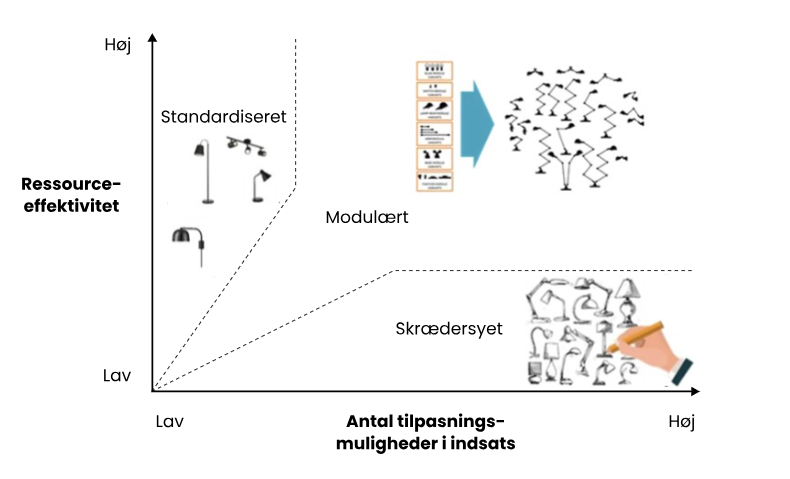
Modular co-creation takes a different approach. Here, you work with many small solutions, much like a solar farm made up of smaller modules. The individual modules can be tested, adapted, and replaced on an ongoing basis, and you can scale up or down as needed. If one module fails, it does not affect the others.
In the engineering world, this has been the standard practice for years. You don’t custom-build every lamp, truck, or hospital building from scratch; instead, you keep standardized components in stock that can be combined in various ways. Take the lamp as an example: a limited number of shades, bulbs, poles, and bases can be combined in countless ways and, together, can meet—not all—but most needs.
Whatever it is, the way you tell your story online can make all the difference.
The same modular approach is gradually gaining ground in social initiatives. For example, the Health Information Committee’s support program for citizens with mental and physical challenges, “Learn to Cope,” is designed so that the program can be adapted to different target groups and local contexts without having to develop a completely new program each time. You can read more about this case here.
Two ways to co-create modularly
There are two main approaches to modular co-creation: top-down (the political approach) and bottom-up (the Røvik approach).
-
Today, when a commission issues recommendations or a reform is adopted, the solution is typically the same everywhere. Imagine instead that the next reform is designed in a modular way:
A few modules are required and set the overall direction.
Other modules are optional.
Each module includes different module options —specific ways to implement the module that municipalities or institutions can choose from.
Over time, the modules can be adapted and additional module variants introduced as we gain insights from feedback on the front lines of implementation.
In this way, the reform will be less like a nuclear power plant and more like a solar farm.
-
Whereas a top-down approach starts at the central level, a bottom-up approach takes the opposite route: In practice, you begin with a wealth of local experiences and trials, and build up from there to develop modules.
The HEL initiative in the City of Copenhagen is an example of this approach. Since 2020, more than 60 local activities have been developed in eight residential areas for children and youth at risk of criminal involvement. These range from basketball clubs and bike repair shops to cooking classes. The activities are co-created with clubs, schools, associations, and social housing initiatives and tailored to the needs of the youth and local resources.
After a few years, efforts began to identify common themes across the board. This work resulted in 10 overarching principles, such as the need for the program to serve as a bridge to employment and community involvement after completion, and the need to remove barriers to participation. These principles serve as the core components.
In a more fully modular co-creation process, the next step would be taken: Under each main module, specific module variants would be developed (different ways to remove barriers, build bridges to employment, etc.), which other municipalities could select, combine, and adapt—rather than having to invent their own solutions from scratch.
The bottom-up approach thus makes it possible to distill insights from numerous local experiments and translate them into a flexible, modular model that can be scaled to other contexts and adapted to local conditions.
Now you’ve gotten a taste of what modular co-creation entails. Perhaps you’re curious about how you can apply this approach in your own organization? At INVI’s Masterclass on wicked , we dig a little deeper. Here, you’ll be taught by experts in various tools for handling wicked , and you’ll apply theories and methods to your own case study, all while collaborating with a network of like-minded peers.
Curious? Then click on the link and read more.
Next time: Large-scale and mission-driven portfolio management
In the next article in ‘INVI’s Atlas,’ we’ll take a closer look at mission-driven portfolio management and show you which tools you can use when your wicked unfolds on a large scale.