Mission-driven change
INVI uses missions as a tool to tackle today’s wicked

Mission-driven change brings together a large group of stakeholders around a shared mission, which they pursue from their own respective perspectives
Through coordination, learning, and integration across sectors, we can achieve a common goal: the many small steps will come together to form one giant leap

A wild world
is pouring down on us
At INVI, we have experience using missions to solve complex societal problems by setting ambitious yet tangible goals that are worth striving for. Just as the moon landing in the 1960s brought together forces across society for a large-scale mission, missions today can be used to tackle some of the most intractable societal problems: youth disengagement, the technological disruption of AI, and the green transition.
In Denmark, we’re generally good at solving problems. But when the challenges change , our old tools don’t always get us where we need to go. That’s why missions are a valuable tool for driving change in areas such as government and organizations.
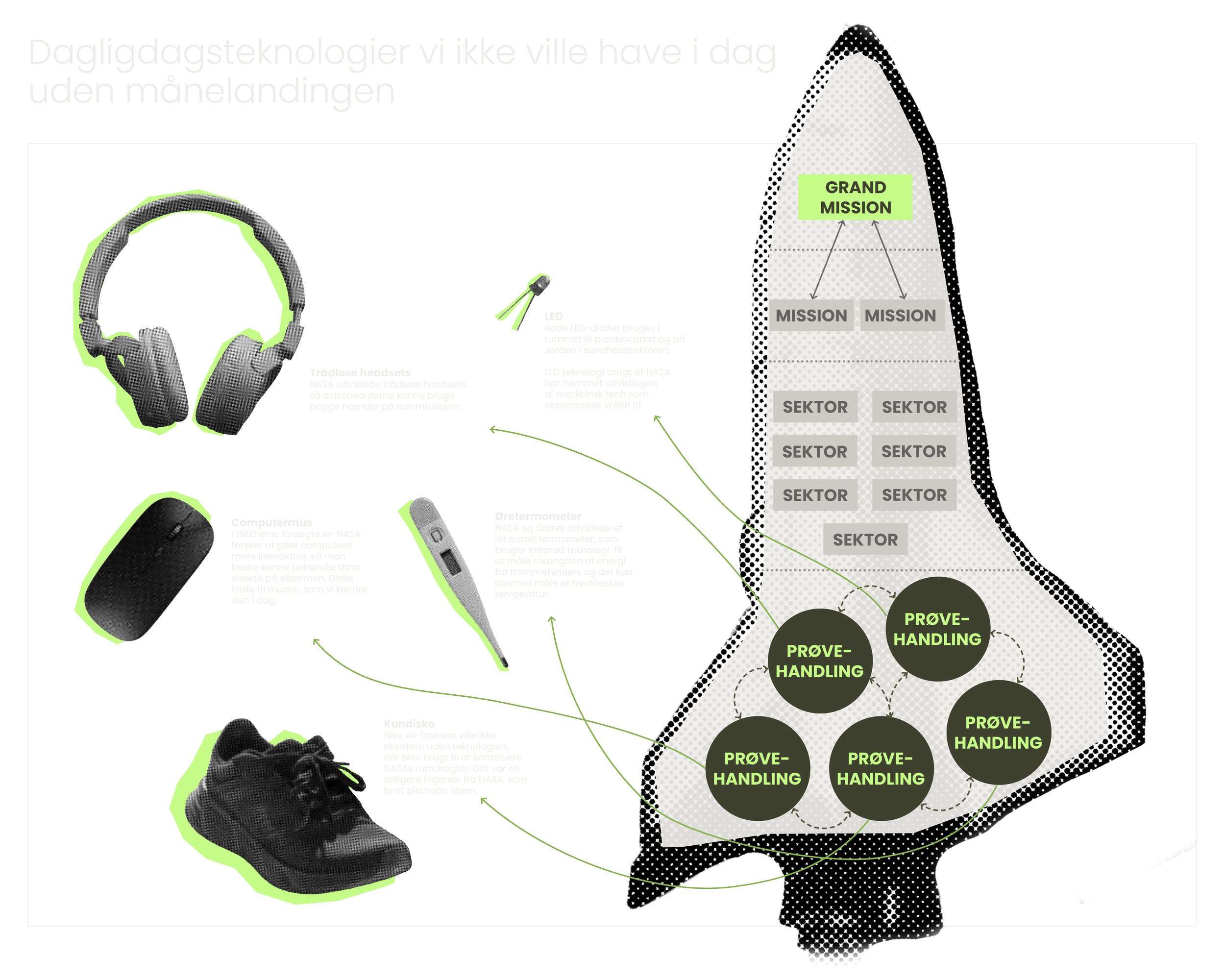
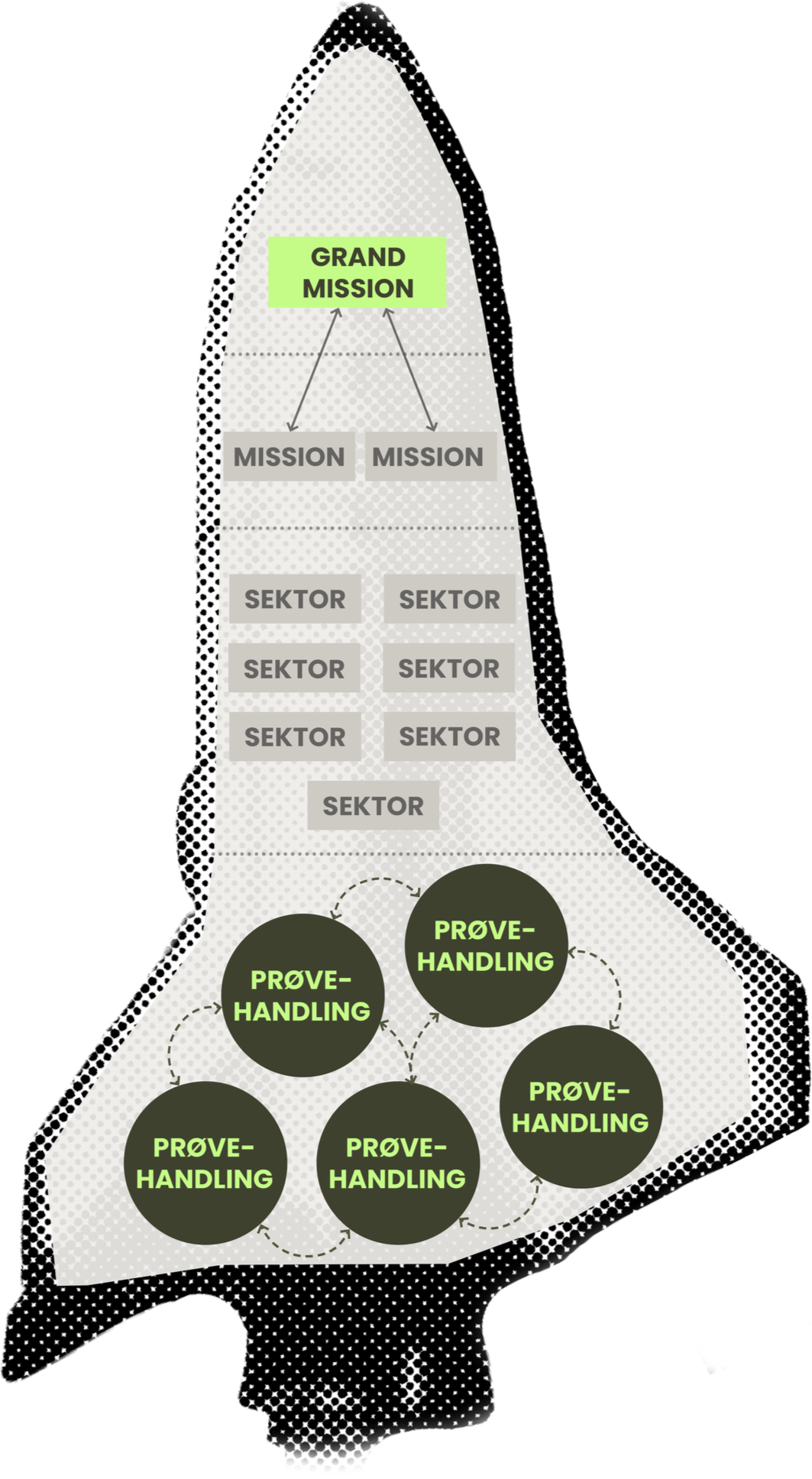
When we establish a unifying mission across sectors and levels, we combine existing structures with an increased ability to learn from many “pilot initiatives” rather than creating a single one-size-fits-all model. In this mission-driven approach, we provide direction rather than regulate, we mobilize rather than dictate, and we are willing to learn rather than control.
Missions are used as a problem-solving tool, for example, at the national level in countries such as the UK, Canada, Australia, and Japan, and at organizations such as Google and the Novo Nordisk Foundation.
On this page, INVI shares our insights into mission-driven change—particularly as a policy tool in the political arena. We highlight hard-won lessons from other OECD countries and provide recommendations for further reading and courses.
From mission to moon landing
What do we do differently when we work on missions?
A mission-driven approach can complement traditional methods when we do not fully understand the causes or solutions to problems—and when there is a need to mobilize many more stakeholders and levels across sectors.
By formulating a “grand mission”—an overarching mission—several sub-missions are created that involve many different sectors, which engage in “pilot initiatives” from which the entire mission can learn. Pilot initiatives are “test runs” that do not need to be rolled out across the entire spectrum before we know whether they work. It is the political world’s answer to a laboratory experiment.
A well-known example of mission-driven change is the U.S. Apollo program, which culminated in the moon landing in 1969. That is why missions are also referred to as “moon landing projects.”
The main goal here was to put “a man on the moon” by the end of the 1960s, and it took many rocket tests before that goal was achieved.
However, the story of NASA’s moon landing is so famous that it overshadows two important insights: 1) that missions require a willingness to learn and grow wiser through trial and error; 2) that missions are about bringing together and coordinating alliance partners rather than commanding obedient subordinates.
In Denmark, we have a number of advantages when it comes to using missions to drive change. We have a high level of trust, a well-educated and competent population, and effective collaboration between the state, municipalities, and private actors. That’s a good start. But we also need to do many things differently when dealing with complex problems such as youth unhappiness, inclusion in public schools, or increasing employment among young people without jobs or education.
Learn how to implement missions in your own organization
Would you, your organization, or your company like to learn more about how to put mission-based work into practice? INVI offers both masterclasses and customized programs tailored specifically to you and your organization.
Read more here about our masterclasses for policy entrepreneurs, where we equip you to work in a mission-driven way in practice.
If a masterclass isn’t the right solution for you, please contact Kristine Fisker at kristine@invi.nu to learn about the many other ways INVI can assist you.

Mission-Driven Change in Practice
Missions are more than just big words and good intentions. They require a clear approach to planning, coordinating, and implementing initiatives—whether in politics, an organization, a business, or a local community.
INVI highlights six key lessons learned from missions in other countries.

❋ Goals worth striving forMissions should inspire people to get involved. They must not be so broad that they lack concrete meaning (“all children should be well”), nor so narrow that they are merely a practical task (“two baths a week for the elderly”). A good mission goal is concrete enough to work with—and ambitious enough to inspire many to build a shared “monument” where they can say, “We created this together.”
❋Joint coordinationWhen many stakeholders are involved, a clear focal point is needed. A single entity or group must be responsible for:
gather insights and experiences
keep track of sub-tasks and projects
ensure that everyone’s contributions work together toward a common goal
When there are many cooks in the kitchen, someone needs to plan the menu and make sure everyone is working toward the same meal.
❋ Continuous learning as a fundamental principleIn a mission-driven approach, you don’t know in advance what will work. That’s why you need to:
test solutions in practice
measure and monitor progress
learn from both mistakes and successes
Missions often go wrong when lessons learned from the “front lines” don’t reach those who plan and make decisions. Continuous adjustments are a prerequisite—not an extra layer.
❋ Requires cross-functional collaborationNo one has the entire solution on their own. Missions succeed only when people work across disciplines, organizations, and groups. This applies to those who plan, those who coordinate, and those who carry out the tasks. Without new forms of collaboration, there is a risk that efforts will become fragmented and lose their impact.
❋ Clear ownership from the startWhat is everyone’s responsibility risks becoming no one’s. Initiatives need clear leadership—a steering committee, core group, or management team—that sets the direction and maintains momentum. Someone must have the courage to take the lead while also delegating responsibilities, so that lessons learned from subprojects and pilot initiatives are actually gathered and put to use.
❋ Capacity, culture, and competenciesIt is easier to articulate grand visions than to put them into practice. Missions require people who understand the mindset behind them: experimentation, cross-functional collaboration, and solutions that are close to the people they affect. This may mean:
training and professional development for employees and volunteers
changes in work culture to create space for experimentation and learning
to bring in new, innovative talent from outside the organization
Without the right skills and framework, missions can easily end up as just another paper project.
Lessons from Apollo 11
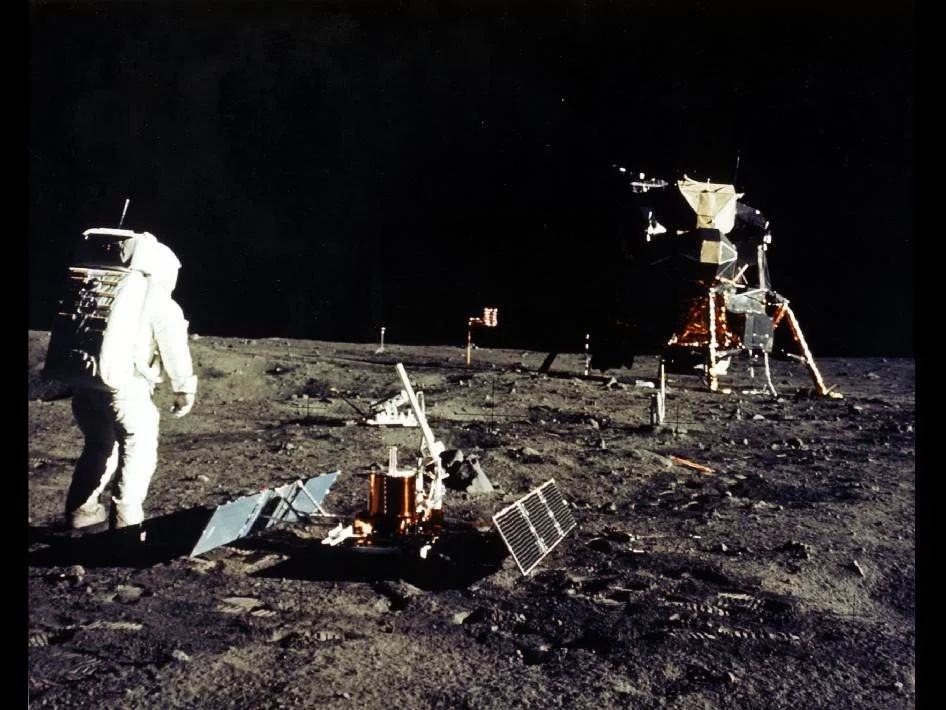
When Kennedy launched the moon mission in 1961, no one had any idea how to get to the moon. However, it was clear that realizing the mission would require extensive collaboration and numerous tests.
In fact, many of the key breakthroughs took place outside of NASA. Computer programmer Margaret Hamilton from MIT wrote the code for the lunar lander. The Whirlpool Corporation developed the freeze-dried food for the mission. Both played a crucial role in the success of the moon landing. Today, we still live in the world of the moon landing through the many amazing inventions that the mission brought about. They all emerged from the mission’s many “trial runs,” which together were necessary to reach the Moon.
Together, these many small steps became the“giant leap for mankind,” as Neil Armstrong, the first person on the Moon, put it.
So the mission ended up being much bigger than the specific goal—it became an inspiration with a lasting impact.
The same could happen with Danish social missions. Who knows what they might bring about?