
Solution lab from idea to action
- Co-create - Roll out - Scale
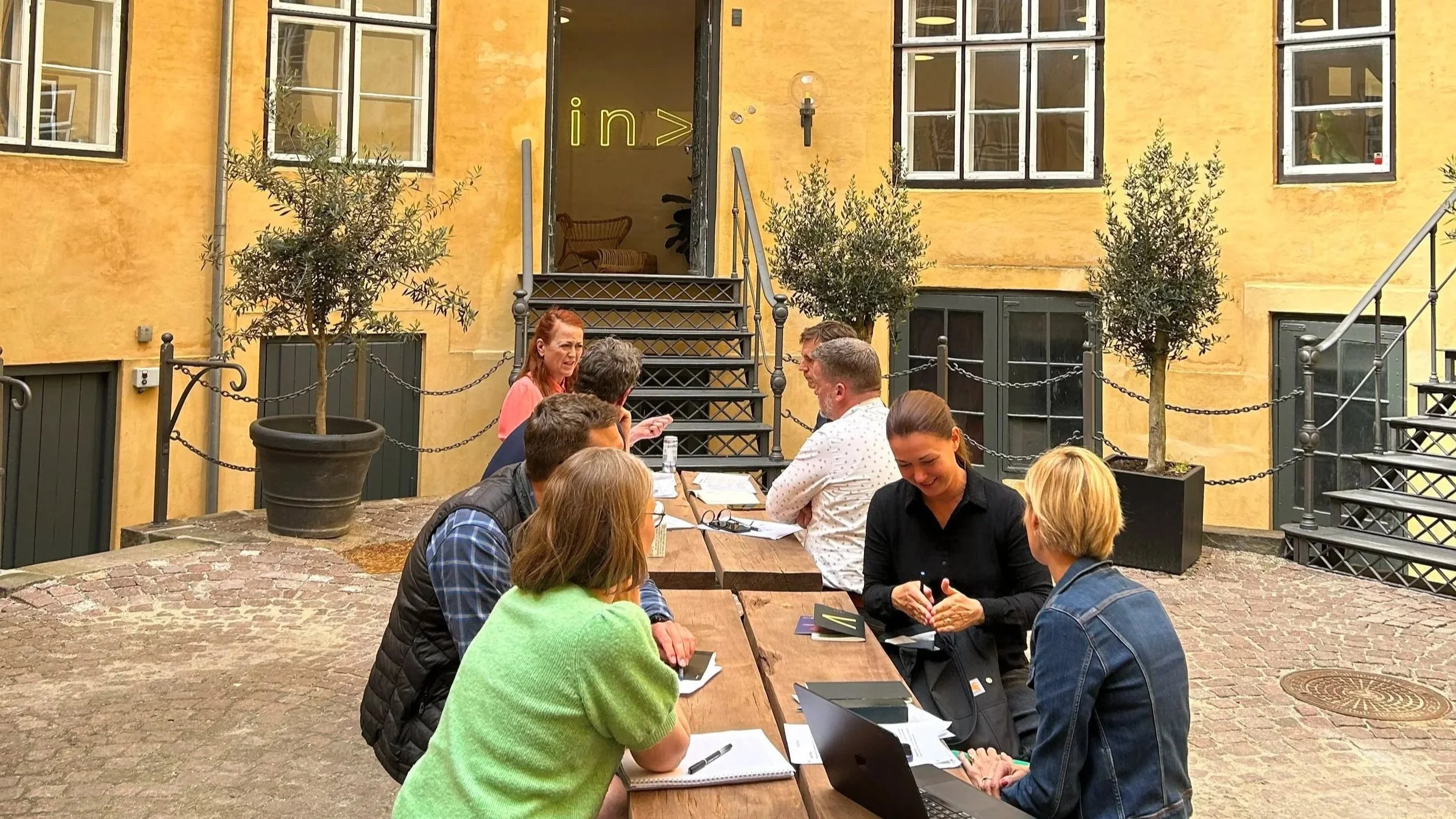
In addressing society’s most complex problems, many organizations find themselves caught between the demands for adaptation on the one hand and resource efficiency on the other. On the one hand, standard solutions are often inadequate. Solutions must be tailored to individual citizens and specific local communities in order to be implemented in practice. On the other hand, there is a need to scale solutions, learn across sectors, and ensure a certain degree of central coordination to avoid unnecessary duplication of effort and the inappropriate use of resources.
At INVI’s Solution Lab, you’ll learn to design and lead the co-creation of modular solutions that can be meaningfully implemented locally while also allowing lessons learned to be scaled across projects, organizations, and local communities. The Solutions Lab is ideal for those who need to support the development of solutions across different stakeholders and balance local adaptation with scalability and cross-cutting learning.
Location
Copenhagen
Duration
3 in-person modules, ½ day online
Price
15,900 DKK, excluding VAT
Next team
Spring 2027: April 13, 2026 – May 20, 2027
Who is taking the course?
Solution Lab is for those of you who are already familiar with co-creation but want to dig a little deeper. You may be working on developing, scaling, and implementing complex social or green initiatives, or on engaging with leadership, politicians, commissions, expert groups, committees, alliances, or partnerships—both locally and nationally.
For example, you could be:
Project Manager or Development Consultant
Program Manager
Senior Consultant
Working with Management Services
Employed by a ministry, a government agency, a municipality, a region, or a political party
An employee of a foundation, NGO, advocacy group, civil society organization, or private company serving the public interest.
Benefits for you and your workplace
Your workplace is getting a new colleague who:
You’ll return home with a concrete action plan for the modular co-creation of an initiative to address a complex societal challenge that your organization is working on
can organize and ensure progress in complex initiatives where the outcome is not known in advance and where ongoing adjustments and collaboration across stakeholders, disciplines, and levels of implementation are required
can design modular initiatives that ensure meaningful local adaptation while drawing on a shared knowledge base and a common DNA, so that solutions do not have to be reinvented from scratch in every new context
can design and lead co-creation processes across disciplines and sectors; they are familiar with the typical pitfalls and the strategies that drive progress, ensuring that these processes are effective, innovative, inclusive, and democratic
has an understanding of various ways to develop and conduct experiments and pilot projects in the search for effective solution modules
has built a strong network spanning ministries, government agencies, municipalities, foundations, civil society, NGOs, and public-sector enterprises
Educators
You’ll be guided through the program by a strong team from INVI, as well as experts from the fields of research, practice, and politics. We’re in the process of confirming the rest of the exciting instructors for 2027. In previous cohorts, for example, we’ve used the green transition and the Green Tripartite as a recurring case study, featuring visits from Jeppe Bruus, then Minister for the Green Tripartite and now Minister of Defense, and Jannik Seslef, chief consultant for the Green Tripartite in Assens Municipality and winner of the Local Government Denmark (KL) Climate Award for the Assens Model.
Eva Sørensen (to be confirmed)
Professor of Public Administration and Democracy at Roskilde University. Eva is one of the country's most cited researchers in the field of co-creation and network governance and has for more than three decades worked on how public governance can be made more democratic and innovative. She has led major national and international research projects and has written a number of key works on collaborative innovation and political leadership.

Kristine Fisker
Program Director at INVI with a background as a design and innovation engineer from DTU. Kristine leads tool development and consulting and strategy initiatives at INVI, and implements modular co-creation in organizations. She has previously worked with systemic innovation and modularization in both the green transition of agriculture and medical technology, and has extensive experience facilitating and structuring complex co-creation processes across organizations. She teaches how to structure co-creation processes that are both inclusive and effective, and how to build solutions using a modular approach, drawing on real-world cases from INVI and other organizations.

Jacob Torfing (to be confirmed)
Professor of Politics and Institutions at Roskilde University and an internationally recognized researcher in co-creation, innovation, and public governance. Among other things, Jacob leads major research consortia such as GOGREEN and the EU Horizon project ROBUST, and has published over 30 books on how public organizations can develop solutions in collaboration with citizens, businesses, and civil society—a topic he teaches at the Solution Lab, from idea to action.

Sigge Winther Nielsen
Director and founder of the think tank INVI. He has previously served as director of DJØF, political analyst at Politiken, host of Deadline, and civil servant at the Ministry of Finance. Sigge holds a Ph.D. in political science and is the author of, among other works, *The Entrepreneurial State* and wicked *. He teaches how to move from analysis to action and how organizations can develop solutions that actually work in practice and navigate the political arena.

Program
The course combines lectures on the latest research in the field with group discussions, exercises, work on individual cases, guest presentations, and group-based reflection.
-
Tuesday, April 13, 2027. 9:15 a.m. – 4:00 p.m.
wicked cannot be solved with standard solutions or by individual actors alone. Problems such as climate change and loneliness require a new approach, in which solutions are developed collaboratively across different stakeholders. They also require flexibility. Therefore, solutions must be built from flexible modules that can be adapted to local conditions. This is the essence of modular co-creation.
In the first module, you’ll receive a thorough introduction to the concept and its practical application. This module provides concrete insights into how you can design co-creation processes that produce modular solutions adaptable across different contexts:
How do you identify wicked problems that require modular co-creation?
How do you put together the right stakeholders across sectors to co-create solution modules?
How do you design and implement a modular co-creation process?
-
Wednesday, April 14, 2027, 9:15 a.m. – 4:00 p.m.
Solutions to wicked problems require local actors to develop and adapt solutions to local conditions and the complexity of the problem. At the same time, we don't have the resources to reinvent the wheel every time. Therefore, we explore how modular co-creation can be used strategically to create solutions that are both practical and democratic and can be scaled effectively.
This module provides you with concrete insights into how to reap the many benefits of co-creating modules:
How do you use modular co-creation processes to foster democratic renewal and interactive political leadership?
How do you ensure both local democratic support and cross-scaling of solutions?
How do you navigate the resource and political dilemmas of co-creating modules?
-
Thursday, April 29, 2027. 9:15 a.m.–4:00 p.m. (followed by a social hour).
Some processes are the backbone of your organization. Others are complex and require significant effort to create value for your workplace. How do you build an infrastructure that makes it easy to develop and roll out solution modules that actually work in practice?
In this module, you’ll gain concrete tools to successfully embed modular co-creation. You’ll learn to navigate the dilemmas and challenges that arise when solution modules are to function in different local contexts:
How do you create a modular co-creation infrastructure to make it easy to develop and deploy solution modules?
How do you create the best conditions for success?
How do you test new solution modules, and how are they integrated into existing work processes if they prove to be effective?
After the module ends, there will be an opportunity to stick around for a drink, some snacks, and some casual mingling.
-
Thursday, May 20 (online). 9:00 a.m.–12:00 p.m.
Learning must be processed and integrated, and it is often during this process that you encounter new obstacles, questions, and dilemmas.
In this online module, you'll have the opportunity to check in and discuss your challenges with instructors and fellow students.
What (new) challenges and obstacles have you encountered, and what can you do about them?
What is the best way to initiate the co-creation of modular solutions in your own context and organization?
Price: 15,900 DKK, excluding VAT
The price includes a light breakfast and hearty lunch during all modules, a compendium and a notebook.
Discounts
Bring a colleague discount
If two or three people from the same organization (same EAN/CVR number) participate, each participant will receive a discount of DKK 1,000. Contact us for a quote if more than three people from the same workplace wish to register for the course.
Early bird discount
If you register by December 21, 2026, you'll receive a 10% early-bird discount.
PIP discount
If you are a member of INVI's Policy Insights Panel, you'll receive a 2,000 kr. discount.
The discounts cannot be combined. If you are eligible for multiple discounts, you will receive the largest one.
Get financial assistance
If you are employed by a municipality, region, or the state, you can apply for grants to cover course fees, transportation, and, if applicable, lodging through the collective bargaining-based skills development funds.
Note:
You can apply for funding no earlier than 9 months before the course starts and no later than the day before the course starts. It’s a good idea to have your application ready before the funding rounds open.
Your manager must approve the application.
Are you unsure which collective bargaining agreement applies to you? Ask your manager or union representative, or check your employment contract.
The State Competence Fund:
The next application period opens on August 10, 2026, at 10 a.m., and closes on August 19 at 5 p.m. Funds are awarded by lottery. Read more here.
The Municipal Competence Fund:
The next round of the Academic Grant Pool opens on September 1, 2026, at 10 a.m. Funding is allocated on a first-come, first-served basis until the funds are exhausted—this often happens within a few hours or days, so it’s a good idea to have your application ready. Read more here.
The Regional Competency Fund:
The next round of the Academic Grant Pool opens on August 12 at 10 a.m. Funding is allocated on a first-come, first-served basis until the funds are exhausted—this often happens within a few hours or days, so it’s a good idea to have your application ready. Read more here.
If you have any questions, or if you have applied for a skills fund and are waiting for a response, we recommend that you contact course facilitator Kristine Fisker at kristine@invi.nu. She can help guide you through the process and secure your spot in the class.
Practical information
The course will be held in person on April 13–14 and April 29, 2027, from 9:15 a.m. to 4:00 p.m. at INVI’s offices at Snaregade 10B, 1208 Copenhagen.
In addition, there will be a half-day online class on May 20 from 9:00 a.m. to 12:00 p.m.
For questions and further information, please contact course facilitator Kristine Fisker at kristine@invi.nu.