
INVI and the Lauritzen Foundation aim to ensure that local social breakthroughs are not lost
A three-year partnership aims to help successful local initiatives continue—without losing the elements that make them effective.
Far too many social initiatives that make a real difference locally come to an abrupt halt when the driving forces behind them leave, or when the lessons learned need to be shared beyond municipal boundaries. Not because the initiatives don’t work—but because our systems struggle to pass on that kind of knowledge.
The think tank INVI and the Lauritzen Foundation will focus on this issue through a three-year partnership. The Lauritzen Foundation has awarded 4,580,000 DKK to the collaboration, which aims to advance efforts to understand how local solutions can benefit more people—without losing local engagement and ownership.
“Time and again, we see that strong, local initiatives turn into local miracles. They work right where they’re created, but they’re hard to scale up nationwide for the benefit and joy of more young and vulnerable people. That’s a shame. Because there is tremendous potential in learning from these positive experiences, but we lack the means to scale these local initiatives—without stifling them all in bureaucracy and a one-size-fits-all approach,” says Sigge Winther Nielsen, director of INVI.
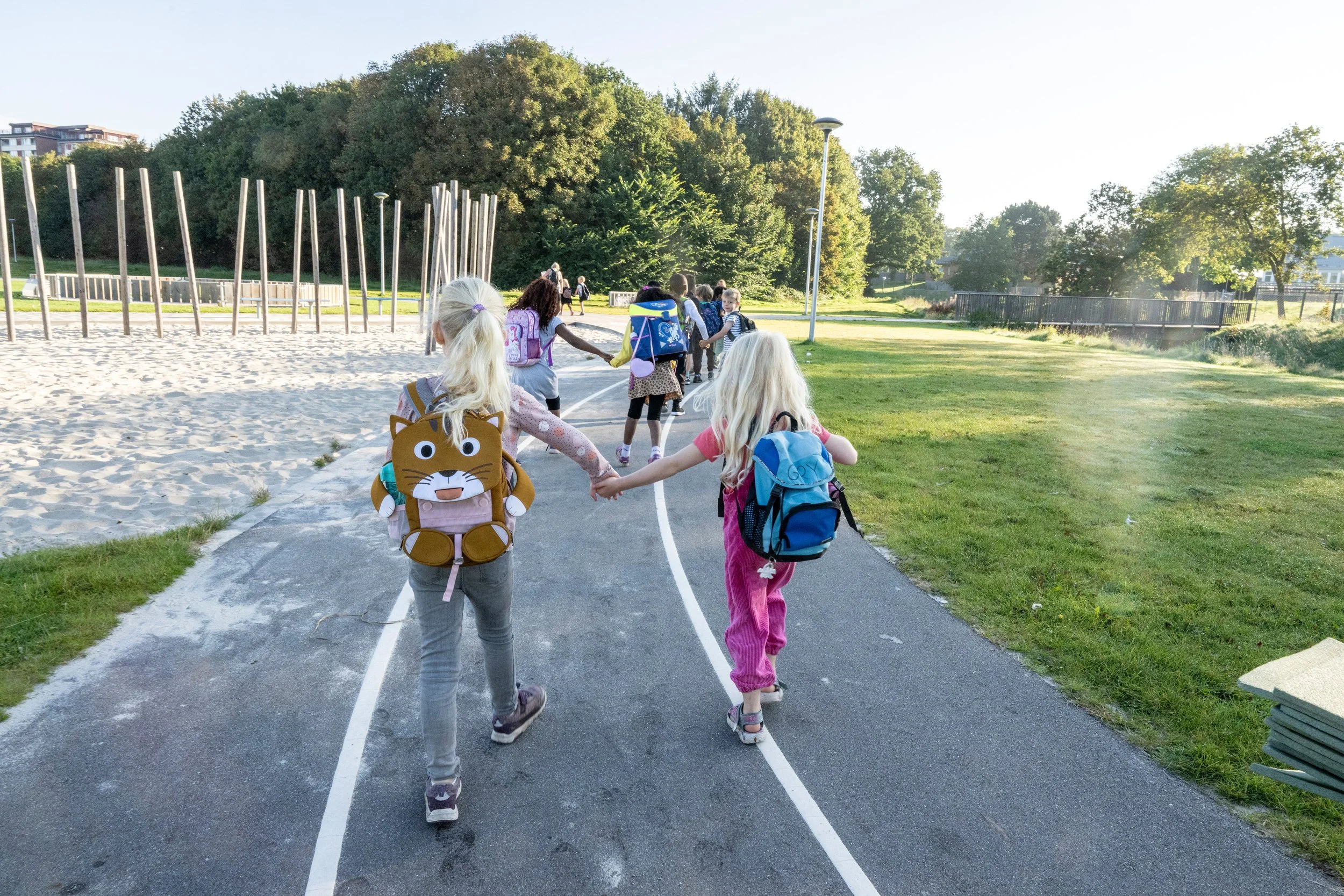
A scene from MedVind in Østerbyen, Esbjerg. Photo: Torben Meyer.
Real-world experiences—not ready-made models
The partnership builds on a year of collaborative work between INVI and the Lauritzen Foundation and is grounded in concrete practical experience. A key example is Østerbyen in Esbjerg, where eight years of sustained collaboration between the municipality, the foundation, civil society, and the business community within the MedVind alliance have, to date, brought about significant improvements for local children and youth in vulnerable situations.
“The experiences from Østerbyen show that change cannot be imposed from above. It is built collectively—through relationships, over time, and with great patience. The challenge is not whether it works, because we can see that it overwhelmingly does. The challenge is how to share these experiences in ways that make sense for other local communities,” says Kathrine Geisler Madsen, director of the Lauritzen Foundation.
That is precisely why the partnership is not about copying or scaling specific initiatives on a one-to-one basis. Instead, the goal is to gain a better understanding of the mechanisms that make local change possible—and of how that knowledge can be applied to new places, new relationships, and new contexts.
A bridge between practice and the system
Over the next three years, INVI will serve as a critical partner to the Lauritzen Foundation. This involves, among other things, professional consultation, constructive criticism, and ongoing reflection on the foundation’s strategic and methodological choices. At the same time, INVI will help strengthen the capacity of both the foundation and selected partners and serve as a bridge to the political and administrative landscape, where these experiences have the potential to be elevated and more broadly implemented.
“As a foundation, we are closely connected to the field. We’re constantly working to understand everyday life, relationships, and the small steps that create big changes locally. But we also need an outside perspective—someone who can ask the tough questions and help bring those experiences into the systems that can carry them forward,” says Kathrine Geisler Madsen.
Among other things, INVI provides an analytical overview and expertise on change, systems, and political processes—and acts as a neutral intermediary that can bridge the gap between local initiatives and the structures that often determine whether those experiences are allowed to endure.
Young people’s perspectives and practical knowledge as a foundation for change
The partnership will also develop new methods to involve young people from the so-called "at-risk group"—the nearly 45,000 young people aged 15–24 who are currently neither in employment nor in education and who often face complex challenges—more directly in knowledge-sharing and decision-making processes.
These practical insights are a key contribution to the collaboration because they provide access to the lived experiences behind the results—all the aspects that are rarely captured in models and reports. Conversely, INVI offers an outside perspective that can help place the young people’s experiences and local insights within a broader context.
“At INVI, we are experts in systems, change, and policy processes that can help give local experiences greater longevity and broader reach. Our role includes providing analytical perspective and helping to translate local realities into systemic opportunities. And as a neutral actor, we can ask some of the difficult yet necessary questions of both municipalities and initiatives—questions that a foundation cannot always ask itself, because there is an obvious power dynamic in the relationship,” says Sigge Winther Nielsen.
The goal is to help foster a new way of thinking about knowledge sharing and embedding in the social sector—where future dissemination begins not with a model, but with a movement.
“This isn’t something we can solve on our own. It takes time, trust, and new alliances. And it requires someone to have the courage to say: ‘We’re going to do this together,’” says Sigge Winther Nielsen.
Fact: Partnership between the Lauritzen Foundation and INVI
Background: The partnership builds directly on a previous development partnership between the Lauritzen Foundation and the Institute for wicked (INVI).
Target audience: Children and young people in vulnerable situations, and those involved in social initiatives across civil society, municipalities, and foundations.
Period: October 1, 2025 – December 31, 2028 (3 years)
Grant: 4,580,000 DKK
Purpose: To enhance understanding of how local social initiatives can be sustained and benefit a wider audience—without losing local engagement and ownership
The partnership focuses on four roles that set the direction, facilitate learning, and ensure buy-in:
Critical Friend: Professional consultation, feedback, and constructive challenge of the foundation’s strategic and methodological choices.
Capacity building: Tailored training programs and networks for the foundation and selected partners.
Bridge-builder (broker): A link between local initiatives, political processes, and administrative systems in a time of reform and change.
Development Partner: Developing new methods to incorporate the perspectives of young people in vulnerable situations into knowledge and decision-making processes.How we harness practitioners’ “collective intelligence”
If you would like to learn more about the partnership between INVI and the Lauritzen Foundation, please contact:
Lars Hvidberg, Senior Communications Officer at INVI, at lars@invi.nu
Jon Fiala Bjerre, Director of Communications at the Lauritzen Foundation, at jfb@lauritzenfonden.com