
INVI ATLAS #2: Tap into the collective sea of knowledge
Groups, when put together correctly, can be surprisingly intelligent and often more accurate than even the most skilled individuals. So when you're faced with a wild problem with uncertain causes, tapping into the collective ocean of knowledge can provide invaluable insights. In this article, you'll learn what collective intelligence is, how you can use it to map and open up a problem, and gain insight into which parts of a strategy process collective intelligence can make a difference.
When the lifeline 'Ask the audience' is used in the game show 'Who wants to be a millionaire', the majority of the audience answers correctly 91% of the time. Similarly, collectives show a surprising ability to predict the future and estimate values with great precision.
A classic example is Francis Galton's 1906 experiment in which 787 participants at a cattle show had to guess the weight of an ox. Although individual guesses varied wildly, the median of all guesses was only 1 percent from the bull's actual weight of 543 kg.
It demonstrates how biases in individual assessments can cancel each other out when many different perspectives are combined. Together, we often know more than a few experts.
Collective intelligence can emerge in groups where people with different skills and perspectives work together to solve complex challenges. Its quality depends not only on the number of participants, but to a large extent on the diversity of their backgrounds, experiences and mindsets.
Do you have a wild problem that you don't know how to tackle, or where you're stuck in locked perceptions and ideas about the causes of the problem? Read how collective intelligence can unlock the Gordian knot by mapping and opening up the problem.

You only see a small part of the problem
Why do we need collective intelligence? Partly because we tend to overestimate how well we understand the big picture of problems. Often our understanding is disproportionately based on our own experiences, the people we interact with and the stories we hear from them. When things need to move fast, as they often do in the political-administrative system, personal stories and experiences are powerful tools. These impressions - from media, networks and personal experience - greatly influence how we understand societal problems and thus the decisions we make.
Geoff Mulgan, Professor and former Director of NESTA, the UK's innovation agency, also describes how limited our approach to a broad understanding of the problem traditionally is:
"40% of our social interactions are with 5 other people, and 60% with just 15 others. It's hard to have a sustained conversation with more than 4 people. It's hard for an intensely engaged group to consist of much more than 12 people. And somewhere around 150 is the typical upper limit for a tight-knit community." This insight from Mulgan is a testament to the silos of knowledge that create blind spots in rapid decision-making processes.
When it comes to wicked problems, there is no single right answer, like in Who wants to be a millionaire? At the same time, the problem cannot be understood from the perspective of a single discipline. If you're going to develop interventions for a wicked problem, it's important to know the topography of the landscape you're sending your intervention out into. We find the same argument in 'Design Justice' from 2020, where Sasha Costanza-Chock emphasizes the importance of involving multiple perspectives when understanding a problem from all angles so we can find the right solutions:
"involving members of the community that is most directly affected by a design process is crucial, both because justice demands it and also because the tacit and experiential knowledge of community members is sure to produce ideas, approaches, and innovations that a non-member of the community would be extremely unlikely to come up with". (s. 94)
Spot new connections
For collective intelligence to be significant and representative at a societal level, it needs diversity of perspectives and a large amount of input. That's why many collective intelligence experts suggest combining human and machine skills, using big data, AI and digital tools to gather inputs and knowledge from a large number of relevant people and sort and analyze patterns in the insights.
Collective intelligence differs from traditional data collection methods such as questionnaires by combining the depth of the qualitative with the breadth of the quantitative. Where questionnaires force respondents into predefined question frames and response options, collective intelligence opens up unexpected connections. The method makes it possible to work with qualitative knowledge on a large scale, where patterns and themes can emerge organically from the participants' own statements and experiences, rather than being limited by the preconceived categories and assumptions of researchers or decision-makers.
What collective intelligence can look like in your work
There are many ways to access collective intelligence, and in INVI's wicked Problems Model, the collective ocean of knowledge is accessed using text-as-data language models. Broadly selected respondents indicate the causes of a wicked problem in free text answers or by recording answers on their phone. By sorting and visualizing clusters of causes, the model provides qualitative insight into which causes the actors close to the problem perceive as most important.
If the dataset is large enough, it is also possible to filter data by gender, age, geography and discipline to see if different groups point to different causes. Such an overview helps decision makers to both understand the problem better and to understand whether they have the necessary knowledge available or if there are blind spots in terms of causes. The model also allows organizations to create a dynamic basis for understanding the causes of problems and get continuous feedback on whether relevant groups' understanding of the problem's causes shifts over time. It also provides a common ground to work from when stakeholder groups come together to work on the problem. An example of an overview of causal clusters generated by the wicked Problem Model can be seen below.
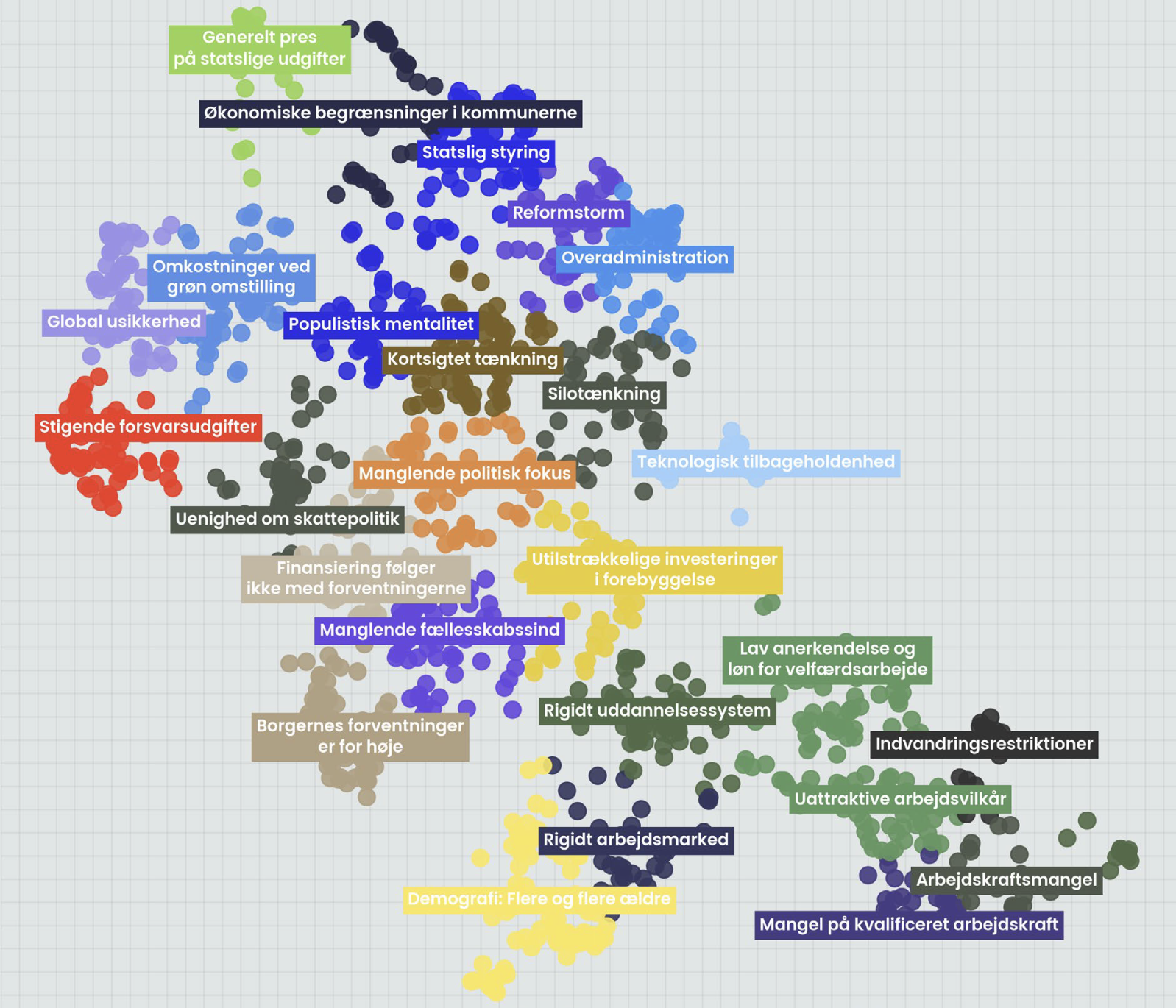
An example of causal clusters from a project with INVI's Model for wicked Problems, showing 403 municipal politicians' free text answers to why welfare is challenged in Denmark.
Why collective intelligence to deal with uncertainty about causes?
1. Dynamic feedback. A wild problem is always on the move. Collective intelligence provides a resourced and scalable way to track how attitudes and knowledge about causes evolve in real-time.
2. Both practical and big picture. Allows you to both dive into qualitative observations close to reality and see the big picture across data.
3. Diversity in knowledge about causes. Shows what different groups think and experience in relation to the wicked problem.
4. Emergence and exploration. Opens up the possibility to explore patterns, causes and insights you can't imagine beforehand.
Collective intelligence in INVI's projects
At INVI, we see collective intelligence as the key to solving many different wicked problems, and as an approach that can create value in several different phases of policy and strategy work: the ideation phase, the formulation phase, the implementation phase and the feedback and evaluation phase. Learn more about how collective intelligence can create value for you and your organization below, and hear examples of concrete applications in INVI's projects.
-
When embarking on a new project, collective intelligence can be used to understand a problem and establish a common ground before a strategy or action is even formulated.
In INVI, we typically ask broad questions - practitioners, users, citizens, employees - to uncover patterns, blind spots and unexpected problem understandings. This provides a common starting point and ensures a broad framing of the problem from the start, not just building on assumptions or narrowing it down around specific interests, but opening up the problem from multiple angles.
In a nutshell: What are people experiencing the problem from different angles?
Read more about INVI's project with the Danish Architects Association and how we used collective intelligence to rethink the design competition as a facilitator for the green transition
-
In the formulation phase, collective intelligence can be used to fine-tune ideas and strategies in draft form. By gathering insights from an entire ecosystem (professional groups, affected citizens, all links in the implementation chain, etc.), the strategy or policy can be adjusted, validated and anchored more legitimately in a relevant cross-section of groups.
In a nutshell: Which of our assumptions hold true - and where does our policy, initiative or strategy need to be adjusted before we press "go"?
As an example, INVI contributed to the Danish Cancer Society's strategy work by inviting five key target groups (patients/relatives, employees, members, volunteers and a control group) to provide input on questions about what the organization is doing well in relation to their mission, as well as suggestions on what can be done better and what should be focused on in the future. In the project, the insights from more than 1,300 people created "thick" qualitative data inputs that enriched the strategy process by confirming or rejecting assumptions, revealing overlooked perspectives, and providing a proportional assessment of how important different focus areas are to different key audiences. This was used to pressure test and align the strategy work and has contributed to a robust strategy with broad legitimacy.
-
Once decisions are made, collective intelligence provides a live picture of what's happening on the front line. We continuously collect input from the actors who will make the initiatives work in practice through continuous adjustment. This allows us to identify what works, where there is resistance and where processes need to be adjusted.
In a nutshell: What happens where policy meets practice - and how should we navigate now?
Read more about how we use collective intelligence to lift the group of young people without jobs or education in a long-term collaboration with the Danish Agency for Labor Market and Recruitment.
-
In the final phase, collective intelligence can also be used to evaluate an initiative after it has been implemented. Here, INVI looks at how stakeholders' perceptions, understandings and needs have changed over time and what unintended effects have occurred along the way. This provides a more nuanced picture than classic evaluations - because we investigate how the initiatives were actually experienced in practice.
In a nutshell: What happened - from different perspectives - and what can we learn for next time?
Want to explore INVI's wicked Problems Model? Then read more here.