
Ars Electronica 2026: Wicked Mirror—when you argue with your own digital twin.
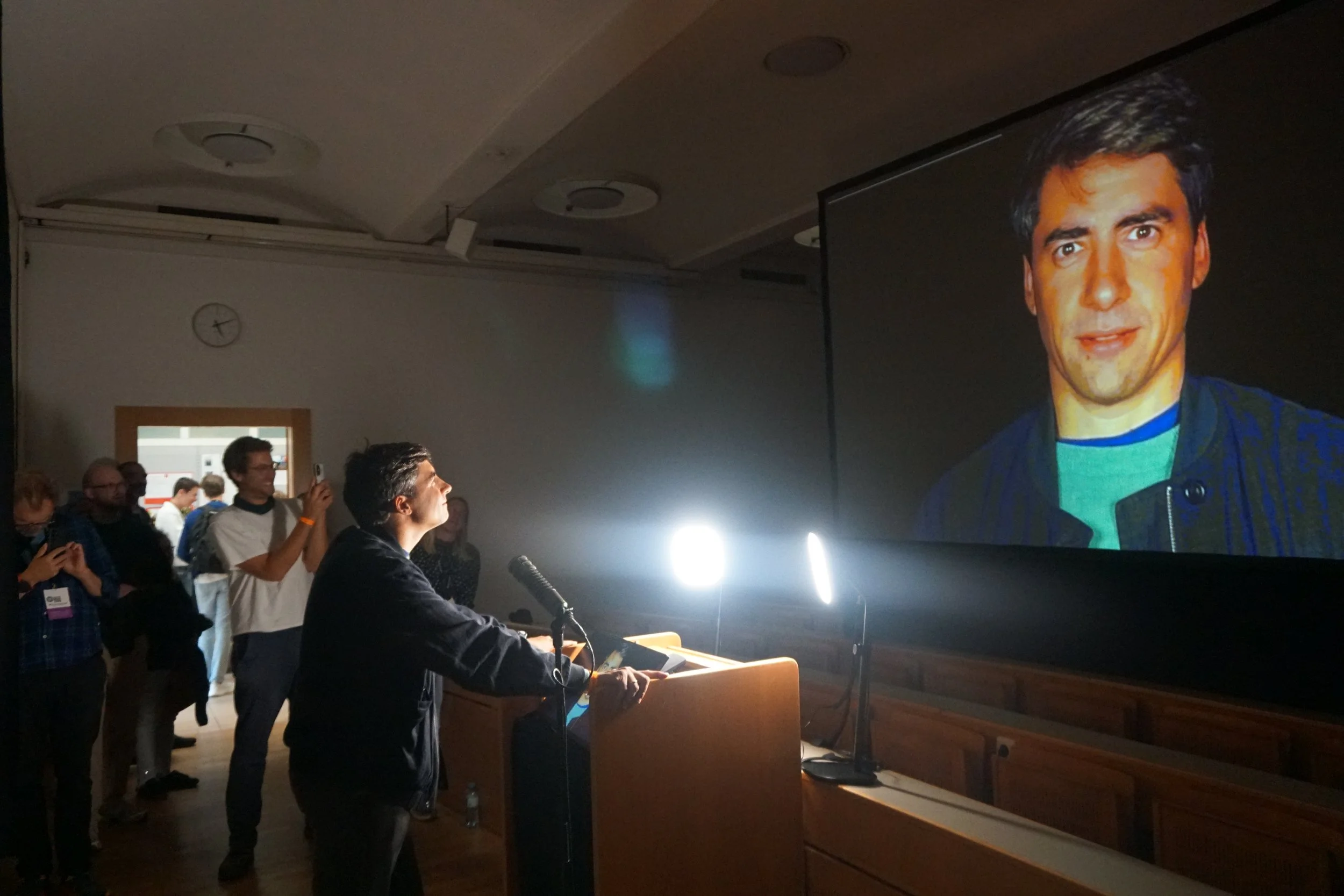
What happens when you encounter a digital version of yourself that believes the exact opposite of what you do? At the Ars Electronica Festival 2026, INVI’s chief analyst Sofie Burgos-Thorsen and artist Andreas Refsgaard tested exactly this with the installation *Wicked Mirror*, in which visitors were cloned in real time by AI and confronted with their own views turned upside down.
Period: 2026
Partners: Ars Electronica Festival (Linz), Andreas Refsgaard (DA)
The project in 5 points:
545 sessions with the AI clone over the five days of the festival
More than 18 hours of uninterrupted conversation between visitors and their digital doubles
Shown at the Ars Electronica Festival 2026, which drew 125,000 visitors and 1,200 participants from 77 countries
Developed in collaboration with digital artist Andreas Refsgaard, known for works such as *In Algorithms We Trust* and *Face2Wikipedia*
Based on INVI’s empirical research on six wicked issues: AI regulation, youth mental health, the green transition, autonomy and dignity in elder care, urban development and housing prices, and trust in institutions
About the project
Wicked Mirror invites visitors to share their views on a “wicked problem,” such as climate change or AI regulation. The installation uses AI technology to clone faces and voices in real time, and moments later, a photorealistic digital doppelganger appears on a large screen and makes a persuasive case for the exact opposite view. But the clone’s argument isn’t random. It’s informed by INVI’s research on “wicked problems” and draws on real insights into what makes it difficult to reach consensus on wicked problems—conflicting explanations of causes and patterns of conflict that characterize genuine societal disagreement. When the clone speaks through your own mouth, it therefore speaks with the same logic we recognize from real- wicked al problems.
Over the course of the festival’s five days, visitors participated in 545 sessions with their clones, and the total duration of these conversations exceeded 18 hours. The installation was part of the festival’s theme, “Future Begins: Negotiating Humanity.”
Relevance
We live in an era marked by growing epistemic fragmentation. Algorithmic platforms have industrialized the production of echo chambers, and political discourse increasingly treats complexity as a weakness and nuance as a betrayal. The consequence is that the very problems that require collective navigation—such as the climate transition, an aging population, or the regulation of AI—are the ones we are least equipped to discuss together.
“Wicked Mirror” does not propose a solution to polarization. The work offers an experience: the sensation of having one’s own sense of security gently shaken, from within. It does not necessarily invite the audience to change their minds, but rather to become more curious about the fact that someone with a different—or even directly opposing—viewpoint is not so different from oneself. In this way, the artwork turns “wicked ’s problems” into something one can experience firsthand—not a policy concept, but something one feels personally and that becomes deeply personal when one’s own face presents an argument one otherwise believed to be wrong.
Our team
Sofie Burgos-Thorsen (project manager).
Andreas Refsgaard (AI artist, external collaborator)
Related news:


Publications:

About the project
With support from the Tuborg Foundation and in collaboration with SAGA, the Institute for Wicked Problems has piloted a new democracy format: The Wicked Week in Parliament. The aim is to create political action through foresight and citizen involvement, especially in relation to complex societal challenges - the so-called wicked problems.
During the test period 2024-2025, responsible AI was explored as a case study, with a special focus on engaging young people aged 18-30. Over 150 young people participated in a process that combined survey analysis, future lab, summit and political consultation.
The ambition is that the Wicked Week in Parliament will eventually become an annual democracy festival with Christiansborg, home to the Danish parliament, as the setting - inspired by the British Evidence Week - where citizens, decision-makers and experts together develop solutions to today's most complex problems.
wicked 's Problems: Anatomy: [ wicked 's problem]
-
Responsible AI spans technology, ethics, law, culture, labor, security and politics. There is no clear professional or institutional framework - and no central authority that can take full responsibility.
-
What is "responsible" depends on who you ask. For some, it's about innovation and competitiveness - for others it's about data security, fairness or transparency. There is no consensus on what the problem is or how it should be tackled. xt goes here
-
AI involves tech giants, startups, researchers, governments, civil servants and citizens - each with their own goals, roles and risks. Power and responsibility are unevenly distributed and no one can solve the problem alone.
-
AI is evolving fast - far faster than political processes and regulation. Today's choices could have unintended consequences in 5, 10 or 20 years. We are designing systems whose behavior we don't fully understand.
How we did it
Describe here what was accomplished during the project. This could be a link to the methods used or a description of the deliverables.
Our team
Name 1 (Project Manager)
Name 2
Name 3