
Local Government Denmark: Four Paths to Sustainability at KL’s 2025 Summit
How can we ensure sustainable welfare in Denmark by 2035? In collaboration with KL, INVI surveyed how the country’s local elected officials themselves view this challenge and translated their responses into four concrete paths forward.
Period: 2025
Partners: Local Government Denmark (KL)
The project in 5 points:
403 local elected officials from 95 of 98 municipalities responded to the survey
The responses totaled 57,498 words of free-form text on the future of welfare
INVI identified 1,374 factors contributing to challenges to well-being, grouped into 26 clusters of causes
Local politicians identified 1,053 solutions, which INVI grouped into 16 solution clusters
The findings were summarized as four paths to sustainable welfare and presented at KL's 2025 Summit
About the project
INVI and KL wanted answers to a specific question: How do local politicians in Denmark themselves view the path to a sustainable welfare system? Instead of surveying a sample of experts, INVI went directly to elected officials and collected responses through an online questionnaire survey conducted from February 5 to March 5, 2025.
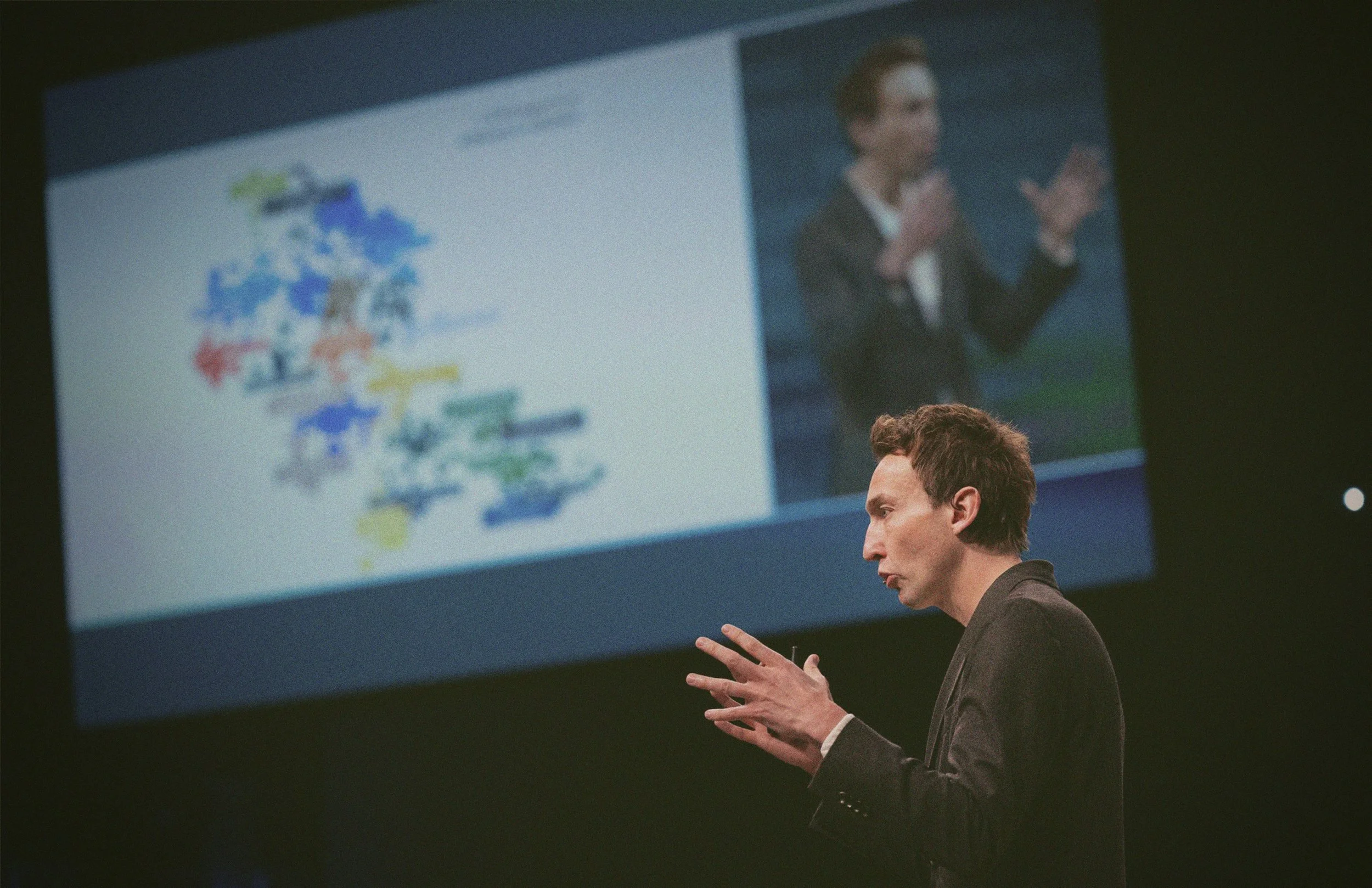
403 local politicians from 95 municipalities described in free-form text the reasons they saw for why the welfare system is under pressure, and the solutions they themselves proposed. INVI analyzed the 57,498 words using the “ wicked ” Problem Model and found that the responses formed clear patterns: 26 clusters of causes and 16 clusters of solutions.
Based on the solution clusters, INVI outlined four ideal-typical paths to sustainable welfare—“Less is more,” “Smarter, not harder,” “Join forces,” and “New deal”—each of which brings together the solutions identified by local politicians. These paths are not mutually exclusive but represent four different directions in which local governments in Denmark can move.
The results were presented at KL's 2025 Summit and provided local politicians and other key stakeholders with a comprehensive picture of where local governments in Denmark see opportunities to ensure social welfare.
How we did it
We used the “ wicked ” Model to transform the qualitative responses of 403 local politicians into a quantitative picture of how much they agree or disagree on welfare challenges and solutions. This method made it possible to identify patterns across nearly 60,000 words—patterns that no single reading could have uncovered—and to translate them into four clear, action-oriented paths forward. Read more about the Model for wicked Problems here: invi.nu/mvp
Dissemination and follow-up work
The results were presented at KL’s 2025 Summit for local politicians and other key decision-makers in local government across Denmark.
Our team
Esben Dahl Sørensen (Project Manager)
Sofie Burgos-Thorsen (Chief Analyst)
Sam Rahbar (analyst)
Mads Højmark Pedersen (analyst)
Related news:


Publications:

About the project
With support from the Tuborg Foundation and in collaboration with SAGA, the Institute for Wicked Problems has piloted a new democracy format: The Wicked Week in Parliament. The aim is to create political action through foresight and citizen involvement, especially in relation to complex societal challenges - the so-called wicked problems.
During the test period 2024-2025, responsible AI was explored as a case study, with a special focus on engaging young people aged 18-30. Over 150 young people participated in a process that combined survey analysis, future lab, summit and political consultation.
The ambition is that the Wicked Week in Parliament will eventually become an annual democracy festival with Christiansborg, home to the Danish parliament, as the setting - inspired by the British Evidence Week - where citizens, decision-makers and experts together develop solutions to today's most complex problems.
wicked 's Problems: Anatomy: [ wicked 's problem]
-
Responsible AI spans technology, ethics, law, culture, labor, security and politics. There is no clear professional or institutional framework - and no central authority that can take full responsibility.
-
What is "responsible" depends on who you ask. For some, it's about innovation and competitiveness - for others it's about data security, fairness or transparency. There is no consensus on what the problem is or how it should be tackled. xt goes here
-
AI involves tech giants, startups, researchers, governments, civil servants and citizens - each with their own goals, roles and risks. Power and responsibility are unevenly distributed and no one can solve the problem alone.
-
AI is evolving fast - far faster than political processes and regulation. Today's choices could have unintended consequences in 5, 10 or 20 years. We are designing systems whose behavior we don't fully understand.
How we did it
Describe here what was accomplished during the project. This could be a link to the methods used or a description of the deliverables.
Our team
Name 1 (Project Manager)
Name 2
Name 3