Cross-disciplinary Insights: New Approaches to Impact-Based Learning
How can a foundation gather insights from the reports of a diverse range of grantees and understand their impact? INVI is developing a new, systematic approach that combines AI-driven document analysis and digital ethnography to gain insights into the impact of the Henry Smith Foundation’s grants.

Period: 2026
Partners: Henry Smith Foundation
The project in 5 points:
The project combines AI analysis of qualitative documents with digital ethnography via INVI's app, Involve
Documents from grant recipients who have received multiple grants constitute the primary data source
The analysis systematically maps out how grant recipients understand social problems, describes change, and documents their impact over time
Through Involve, a group of practitioners contributes perspectives on impact and learning issues that cannot be addressed solely through document analysis
The project provides specific recommendations on how AI-based methods can strengthen the Henry Smith Foundation’s learning infrastructure in the future
About the project
Many foundations fund projects that work toward complex, long-term social change. At the same time, most foundations use measurement tools that are better suited to short-term and linear initiatives. As a result, important insights from project practices remain inaccessible to the foundations; this knowledge is scattered across individual documents and is rarely analyzed systematically across a foundation’s portfolio.
Henry Smith’s grantees—particularly those who receive repeat grants—document their experiences over several years through applications, annual reports, and final reports. In these documents, the organizations describe how they understand the issues they are addressing, what they plan to do about them, and how they expect change to occur. This represents an untapped resource for strategic learning.
INVI, in collaboration with the Henry Smith Foundation, is conducting a pilot project that explores what is possible when using AI-based data analysis—combined with an ethnographic perspective—to map and compare how grant recipients define needs, describe change, and document impact over time. At the same time, through INVI’s app, Involve, we are collecting qualitative perspectives directly from grant recipients on questions that cannot be answered through the documents alone.
The project directly supports the Henry Smith Foundation’s “Elevate Your Impact” (2025–2030) strategy and its commitment to listening to and learning from grantees’ experiences and to testing new approaches to understanding impact.
This is how we do it
The project is structured as an iterative sandbox experiment with five phases that follow a double-diamond process—from idea development and exploratory analysis to prioritization, in-depth analysis, and strategic communication.
We work with INVI’s Model for wicked Issues, which uses large language models and semantic mapping to analyze large volumes of qualitative data without losing nuance or context. The model makes it possible to identify patterns, trends, and blind spots across grant recipients and funding periods.
In this project, we have been working on:
-
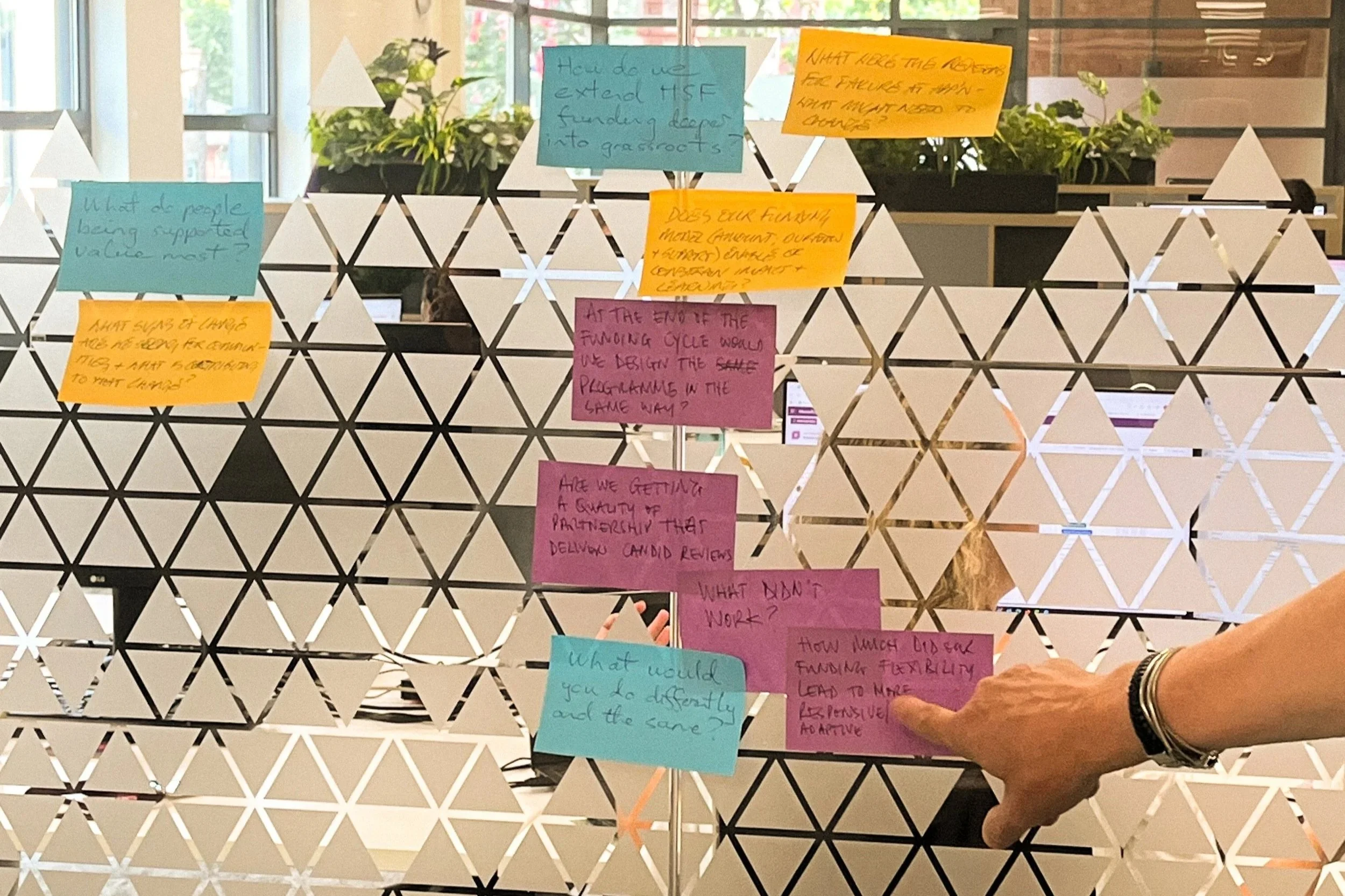
Working closely with Henry Smith’s team, we identify key strategic questions regarding impact and learning and translate them into concrete, testable hypotheses for AI-driven qualitative analysis.
-
We conduct simple analytical experiments on actual documents from the Improving Lives program to assess which hypotheses are technically feasible and analytically meaningful.
-
Based on the initial tests, we jointly select the most promising questions for in-depth analysis. We also identify questions that require direct input from grant recipients and use Involve for digital data collection.
-
We conduct in-depth AI-powered analyses for each priority issue and produce visual and thematic outputs that can support strategic learning and reflection.
-
We synthesize the insights across the analyses and work directly with Henry Smith’s team to assess the strategic value, scope of the methodology, and future applications.
Further work and dissemination
The project will conclude with a catalog of insights that includes a summary of key impact patterns at the portfolio level, an assessment of the strengths and limitations of AI methods, and prioritized recommendations for next steps—including opportunities for further development of a common impact framework, interactive analysis tools, and deeper practitioner involvement through Involve.
Our team
Sofie Burgos-Thorsen (project manager)
Esben Dahl Sørensen, Anna Shams Ili


Publications: