
The Ministry of Senior Citizens has just published the first part of INVI's report on how the core values of the senior citizen reform are perceived by practitioners and senior citizens in elderly care, and the report is already leading to considerations on how the reform should be implemented. This is the first time that Danish politics has gained ongoing insights through feedback loops on how a reform works in practice. Read the full report here.
"The survey indicates that the intentions of the Elderly Care Act are not just words on paper, but that they are largely understood in practice, where the reform is to take effect," says Minister for the Elderly Mette Kierkgaard (M) in a press release. "I am incredibly pleased and it confirms that we are on the right track and that the reform is already gaining ground."
INVI Director Sigge Winther Nielsen says: "We are very pleased that our methods are now proving their worth in practice. It is a major challenge for political reforms that it often takes many years to find out whether they work. At INVI, we are working intensively to build tools that continuously deliver insights from the front line of welfare, where the reforms are to be implemented in practice: Are the measures working as intended? Are there barriers that need to be removed? We have already gained a much better understanding of this from the report on the elderly care reform.”

Frederik from INVI collects data
How we activate the “collective intelligence” of our interns
INVI uses broadly composed "practice panels" to gather insights while a reform is underway, so that both politicians and authorities quickly receive feedback on how the reform is working and how it is perceived by those who work with its implementation on a daily basis. Through the use of AI, the collective intelligence of a broad cross-section of practitioners close to elder care, as well as the elderly themselves, is activated, allowing local experiences and good solutions from across the country to come into play.
For the ongoing measurements of the elderly care reform, INVI's practice panel is composed of 1,026 participants from all parts of elderly care: from managers and civil servants to social and health care workers, volunteers, elderly people, and relatives. Using INVI's tools, they can share their experiences in their own words and point out challenges and improvements related to the three values that the elderly care reform aims to strengthen: i) self-determination for the elderly, ii) trust in the professionalism of employees, and iii) interaction between authorities, the elderly, and civil society.
INVI does not use traditional opinion polls with fixed response categories and ratings from 1 to 5 for specific elements of the reform. Instead, all participants are invited to express their views through free text, audio, and video. There is room for both frustrations and good advice on everything from professionalism to co-determination: What themes and dilemmas are at play, and what actions support the value? Participants share their knowledge based on their own personal or professional experience, and all feedback is anonymized so that neither criticism nor praise can be traced back to a specific person, institution, or municipality.
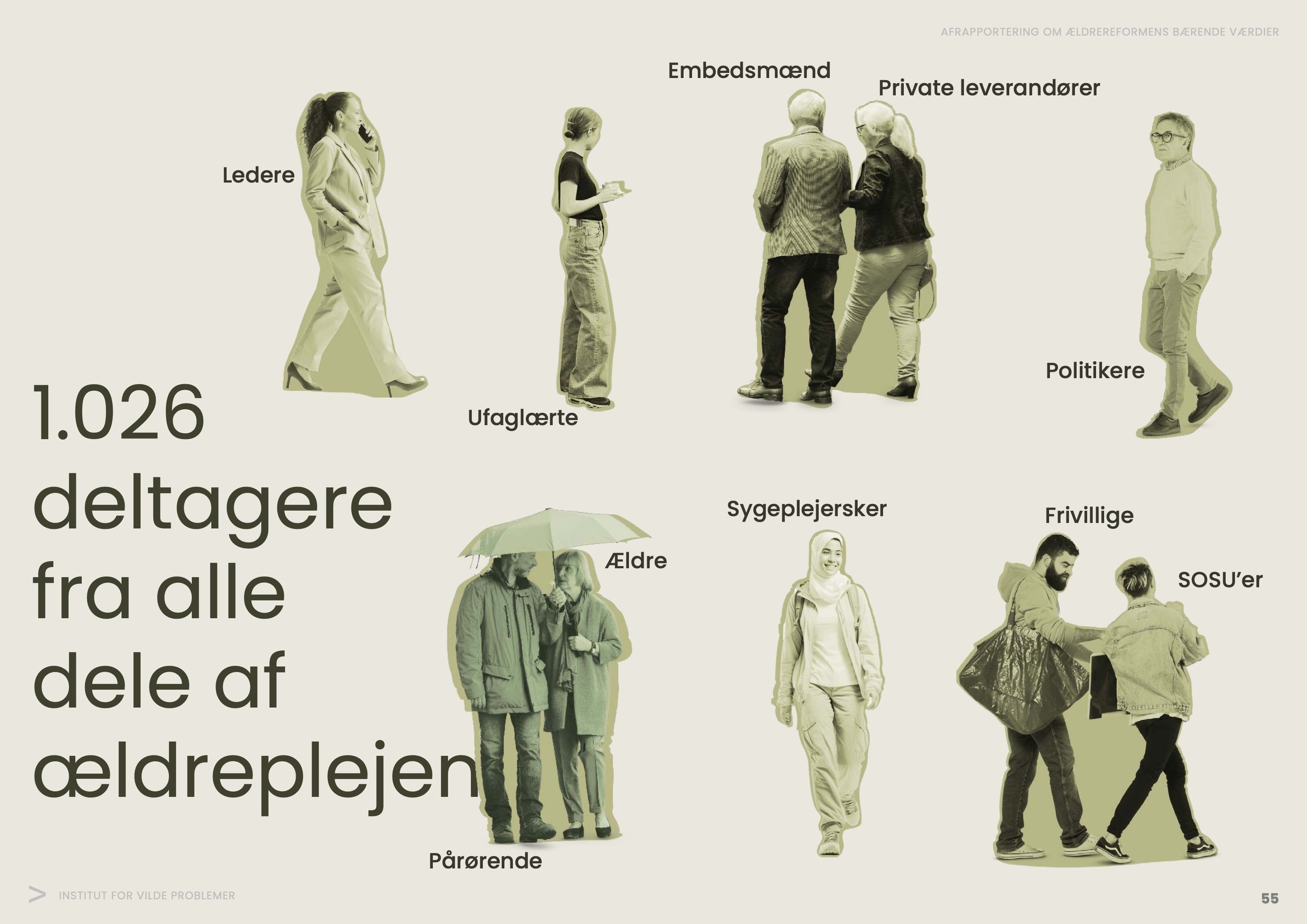
Archetypes of participants in INVI's practice panel
Enough material for an entire book—and then some
From the 1,026 members of the practice panel, over 5,000 responses totaling 168,980 words were received for the first report. That is actually 20,000 more words than in Sigge Winther Nielsen's latest book, "The Puzzle State,"which is otherwise a veritable tome. This enormous amount of qualitative material would take a very long time to process using traditional methods, where, due to the large scale, there would rarely be room for real qualitative contributions.
INVI uses AI to process the many considerations, opinions, and assessments from the practice panel, and we leverage the power of large language models to find clear patterns in the data. Politicians, civil servants, and leaders can respond to these patterns and trends even as the reform is being rolled out, while also qualifying the patterns with specific statements from practitioners.
The patterns in a report can, for example, be used to identify various barriers to the values being put into practice, as well as suggestions for good solutions that can promote the values. In this report, for example, descriptions of 43 barriers have been identified, while 38 solutions have been pointed out – but it is important to note that the numbers should not necessarily be compared. It is not a case of “43-38” challenges, and it does not mean that there are more barriers than solutions for the reform. The patterns must always be further qualified and should be seen as a starting point for planning further work: Are there any "low-hanging fruits" that we can pick right away? Is there a good solution that can remove five barriers in one fell swoop?
For Minister for Senior Citizens Mette Kierkgaard, INVI's initial report has already made it clear that something must be done to clarify that senior citizens have the right to choose between municipal and private care providers:
"The temperature reading indicates that many elderly people are unaware of their right to choose between a municipal or private care provider. This worries me, because it is something that the new large-scale user satisfaction surveys have also indicated. Self-determination is crucial for good elderly care, but it requires that people know they have that right. That is why we must become better at making the choices clear to both the elderly and their relatives," says the Minister for the Elderly.
The difficult interplay
While the report shows that there is broad agreement between nursing homes and the Danish Parliament on the understanding of the values of self-determination and trust, there is still work to be done on the value of interaction between authorities and, for example, voluntary associations, which is expected to have a significant impact on the quality of life of the elderly.
INVI's report shows that while legislation focuses more on the responsibilities of the authorities and the degree of obligation in the collaboration, the practice panel focuses more on the practical tasks and situations where interaction arises and can be challenging: Who takes the lead when the task needs to be initiated, and who is responsible if a mistake is made?
The Minister for Senior Citizens concludes that "an important task lies ahead when it comes to developing the interaction between eldercare, relatives, volunteers, and local communities. A good life for the elderly is not just about the help you receive, but just as much about communities and relationships in everyday life. I look forward to us all getting off to a flying start here in 2026."
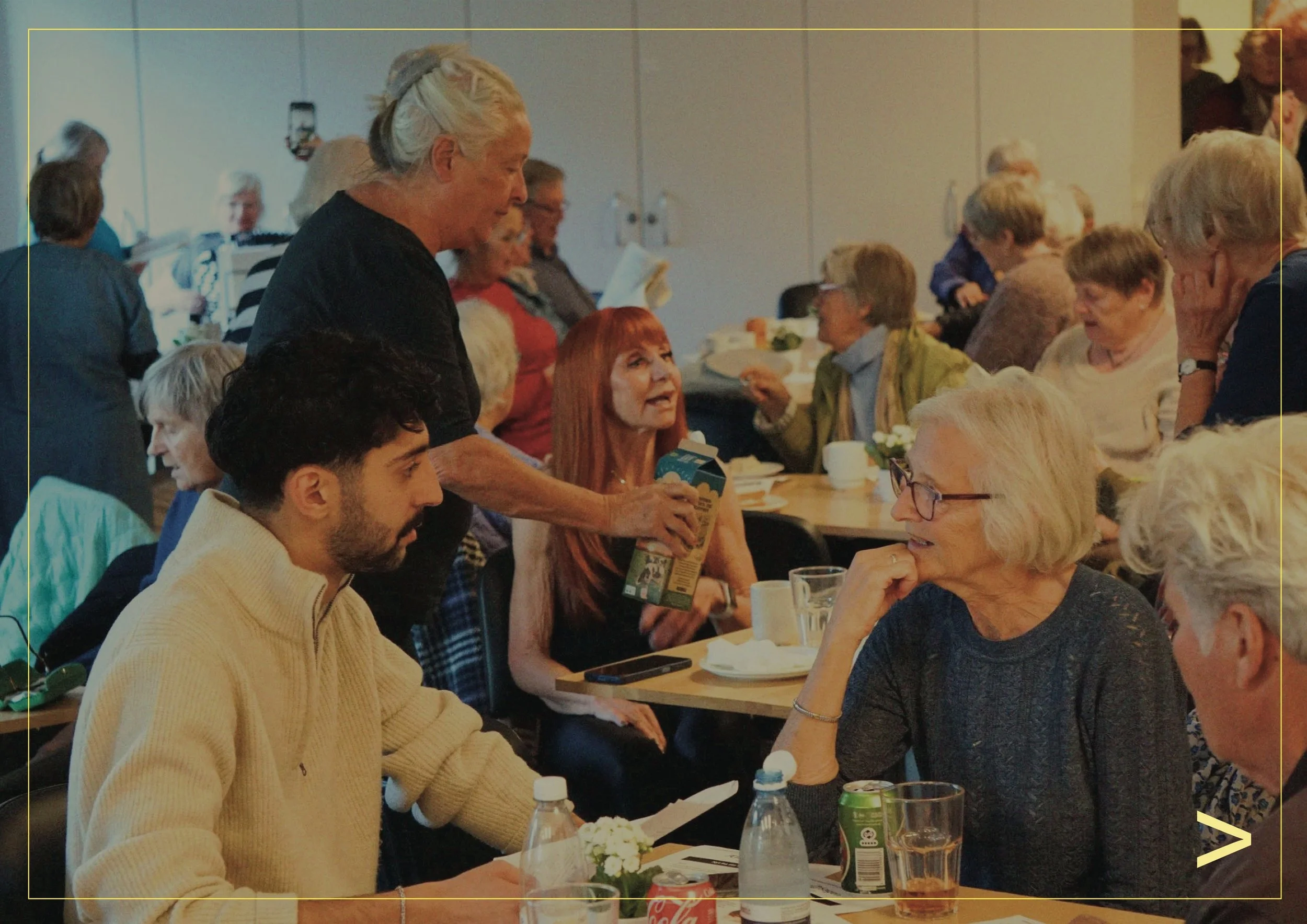
Sam from INVI collects data
Sigge Winther Nielsen points to the differences in understanding interaction as the most interesting insight from INVI's report:
Values such as self-determination, trust, and interaction are not values that can be promoted with the stroke of a pen from Christiansborg. They must resonate all the way from Slotsholmen to municipalities and nursing homes across the country. That is why it was a really good idea for the group behind the elderly care reform to decide that they wanted ongoing insights from the front line of the reform. We are now seeing the first tentative steps towards ongoing reporting leading to adjustments to the reform. This points to the fact that, across the board in politics, we need to involve practitioners much more, instead of believing that we can design everything from the Danish Parliament.
“I believe that in the future we will see many more of these types of ‘test-learn-grow’ processes, where we gather input from practice, which is then turned into insights we can act on, thereby creating new initiatives. This is democratic innovation unfolding in practice, which many abroad are also following with great interest.”
Power of Change 2026
INVI's work on the elderly care reform will be a focal point at the Forandringskraft conference on February 3 and 4, 2026, in Copenhagen. Both Sigge Winther Nielsen and Minister for the Elderly Mette Kierkgaard will participate and discuss, among other things, the idea behind the study, what we can gain from it, and what it will mean in the long term for the implementation of policy.
INVI's work on the elderly care reform will continue throughout the year. Read more about this work here.